
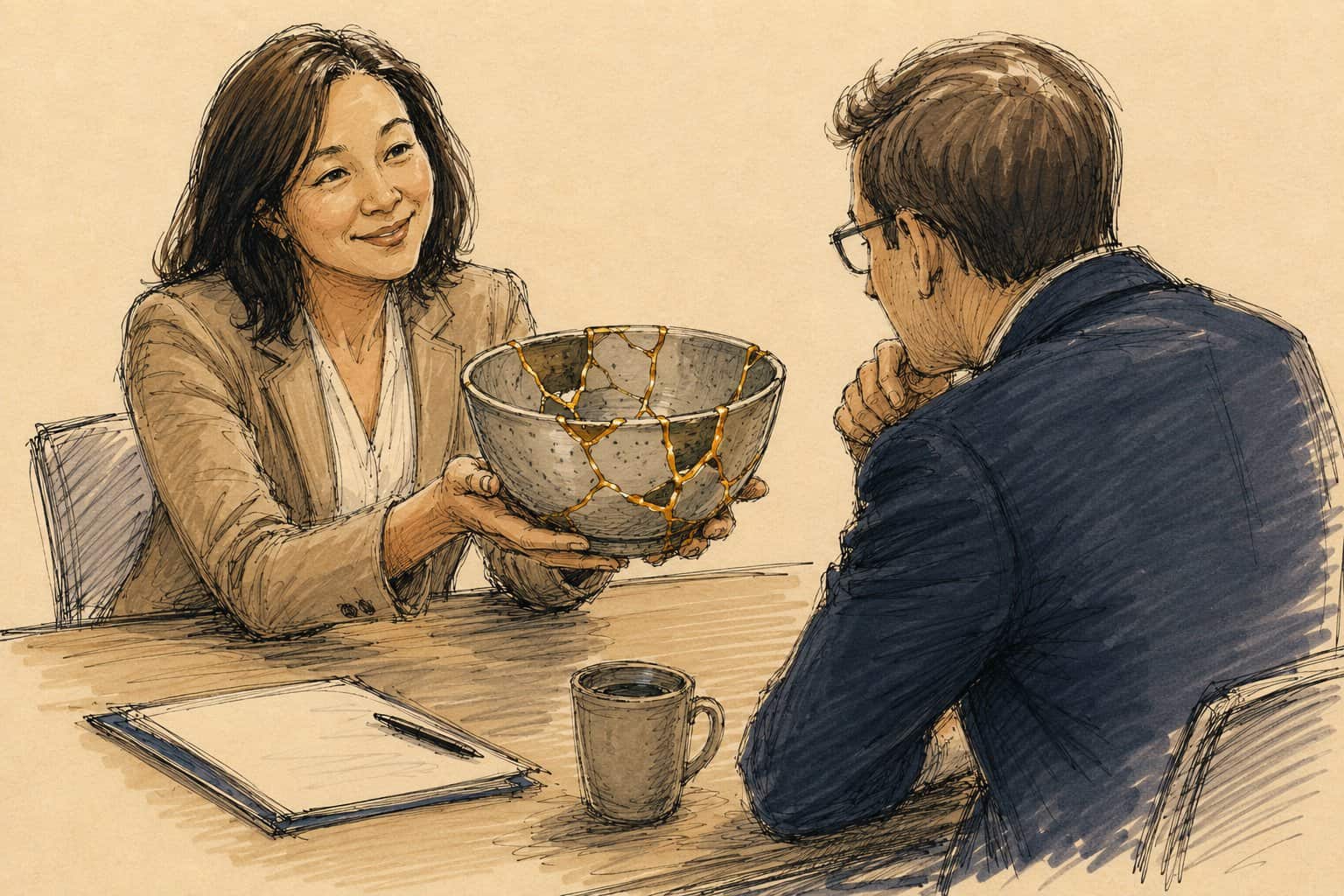
Two interview questions strike fear into almost everyone:
“Tell me about a failure.”
“What’s your biggest weakness?”
These questions hold a strange place in the interview. Everyone knows they’re coming. Everyone dreads them anyway. And most people – including very senior, very capable people – still plan to wing them.
Think about that combination for a second. You know the question is coming. You have unlimited time to prepare. And your plan is… improv?
If you know a question is coming, you don’t wing it. You prepare – to the point where you’re actually looking forward to it. That sounds impossible right now, I know. Stay with me.
What these questions are actually testing
Occasionally, these are gotcha questions. Some interviewers use them to watch you squirm, and there’s no winning a gotcha – only making it less bad. But that’s the minority case, and the preparation that handles the honest version handles the gotcha version too.
Most interviewers are asking something much simpler: do you have self-awareness?
Because here’s what’s true of everyone, including the person interviewing you: we’ve all failed, and we all have weaknesses. Not cute weaknesses that conveniently don’t matter. Weaknesses that affect our actual job performance. This is just reality.
So when a candidate says “I can’t really think of one,” or offers the classic “I work too hard,” the interviewer hears one of two things: this person doesn’t know themselves, or this person isn’t being straight with me. Neither gets you hired.
The answer that works has three parts: a real weakness, a clear picture of how it shows up in your work, and the system you’ve built to manage it.
That’s not confessing. That’s demonstrating the exact self-knowledge they’re screening for.
But to give that answer, you have to actually know your weaknesses. Which is harder than it sounds – and the reason is interesting.
Why you don’t know your own strengths (or weaknesses)
A few years ago I took the Clifton StrengthsFinder assessment. (If you haven’t: it’s not perfect, but it’s reasonably research-based, its results are stable over time, and it aligns well with other strengths assessments. Good enough to be useful.)
One of my top strengths came back as Ideation – the propensity to generate lots of new ideas.
My first reaction: that can’t be right. If you’d asked me before the assessment, I’d have told you “I’m not very creative.”
But I sat with it. And I realized that whatever problem I’m handed, I automatically start generating multiple solutions – especially ones nobody’s tried yet. Every time. Without deciding to.
I never counted that as creativity, because it didn’t feel like anything. It felt like just… thinking. Doesn’t everyone do this?
Apparently not.
There’s a saying I love: “Your obvious is your art.” The things that come easiest to you are often the rarest things about you. But because they’re effortless, you assume they’re universal – and they become invisible to you.
Here’s the flip side, and it’s the part that matters for our two dreaded questions: your weaknesses are invisible for the opposite reason. You’ve spent years quietly compensating for them, so you rarely have to look at them directly. An outside instrument – an assessment, a trusted colleague, a coach – often sees in minutes what you’ve avoided naming for a decade.
The weakness that should have disqualified me
The same StrengthsFinder results gave me a small panic.
Clifton divides strengths into four domains: Strategic Thinking, Relationship Building, Influencing, and Executing. My results: strong on strategy and relationships. Executing? Way down the list.
I’m a product manager. Product management, whatever else it is, is about getting things done. How could I do this job without any natural strengths for getting things done?
Two thoughts hit me almost at once.
First: oh, that explains a lot. I’ve never been naturally good at execution. Seeing it in the data was almost a relief – like finally getting a diagnosis for a symptom you’d been explaining away for years.
Second, and more interesting: then how do I get things done? Because I do.
The answer turned out to be that I execute through my other strengths. My strategic side often catches that the thing I’m about to grind on isn’t the right thing at all (the best execution move is frequently “don’t”). My relationship side recruits people who are great at execution and happy to help.
And when I just have to do the thing myself? I use scaffolding. Detailed step lists. “Just get started.” “The simplest thing that could possibly work.” Tools that people with natural execution strengths never need – because for them, it’s automatic.
Putting it together in the interview
Everything in that last section – the weakness, how it shows up, the system – is my answer to “what’s your biggest weakness?”
Notice what that answer does. It names a real weakness, one that’s genuinely relevant to the job (that’s what makes it credible – a weakness with no stakes is a dodge). It shows I understand precisely how it operates in my work. And it shows a functioning system for managing it, built from strengths I can also name.
Thirty seconds, no squirming. And the interviewer learns more about how I actually operate than they’d learn from three of my wins.
“Tell me about a failure” works the same way. A real failure, what it cost, what you understood afterward that you didn’t understand before, and what you do differently now. The failure isn’t the point. The self-awareness arc is the point.
So here’s the preparation, concretely:
- Get real data on your strengths and weaknesses. StrengthsFinder is one way; honest feedback from people who’ve worked with you is another. Your self-image is not a reliable source – mine said “not creative” and “gets things done fine,” and both were wrong.
- For your biggest job-relevant weakness, write down how it actually shows up in your work. Specifics, not categories.
- Name the system you use to manage it – and notice that the system is usually built from your strengths.
- Do the same arc for one real failure: what happened, what it cost, what changed in you.
Do this once, properly, and these two questions transform. They stop being the scary part of the interview and become the part where you demonstrate something most candidates fumble: you know exactly who you are and how you work.
This is the same skill as writing a resume that gets interviews, by the way. Both require seeing yourself accurately – including the strengths that feel too obvious to mention. If your resume isn’t getting interviews, that’s usually where the problem is, and it’s what I work on with clients every week. You can book a free resume review here.
Bottom line: everyone has weaknesses and everyone has failures. The candidates who get hired aren’t the ones who hide that best. They’re the ones who understand it best.