
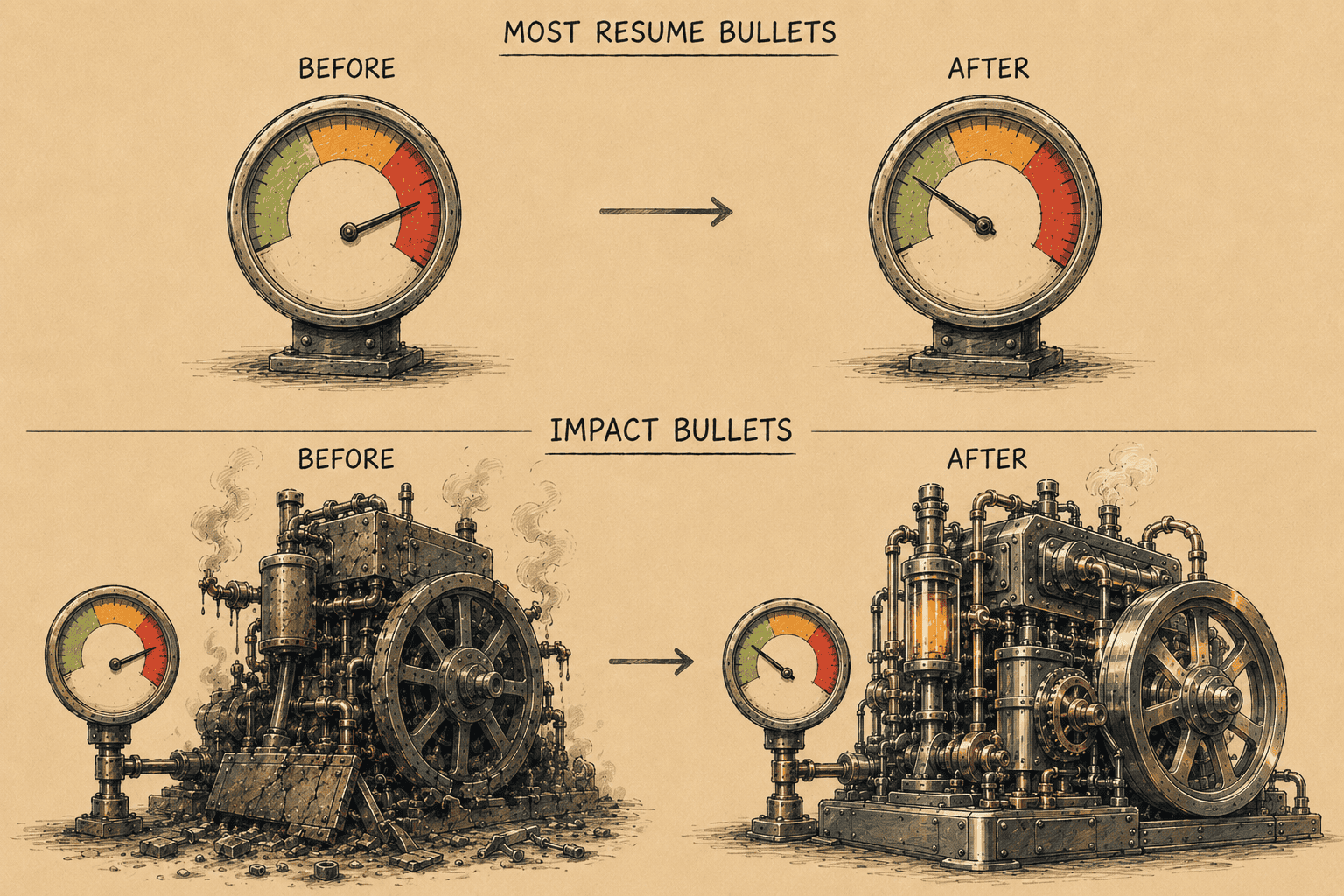
Most product managers have real numbers on their resume. That’s not the problem.
The problem is that the numbers aren’t doing any work.
Here’s what I see constantly. Someone sends me their resume and it’s full of bullets like:
- Increased conversion rate by 12%
- Reduced churn by 8%
- Improved NPS by 15 points
Real numbers. Real outcomes. And yet the resume isn’t getting interviews.
Why? Because a percentage floating by itself is a claim, not evidence. And hiring managers – who are scanning 200 resumes on a Tuesday afternoon – can’t feel the difference between a genuinely impressive number and one that sounds like every other resume they’ve read that day.
The fix isn’t to make up bigger numbers. It’s to use your real numbers correctly.
A Metric Without Context Is Noise
Typical resume bullets are like:
- “Drove checkout changes that resulted in a 12% conversion rate improvement”
Here’s the thing about “12% conversion rate improvement.” I don’t know what to do with it. I don’t know your baseline. I don’t know the industry benchmark. I don’t know what you actually did or why the 12% happened. I don’t know if 12% in your context is a home run or a rounding error.
It’s a metric pretending to be an accomplishment.
Now read this version:
- Inherited a checkout flow converting at 2% – half the industry benchmark. My discovery revealed four key friction steps. I drove leadership approval to build a redesigned flow and launched in three months. Conversion improved by 6x, revenue attributed to this flow doubled, and my approach was reused for other flows.
Same underlying win. Same person. Same work. Completely different bullet.
One reads like a line item. The other reads like someone who finds problems, gets people aligned, and fixes them.
That’s the gap. And it’s fixable.
(I call these “Impact bullets,” by the way).
Two Things Changed – And Both Matter
When you compare those two bullets, two distinct things happened.
First, the metric is anchored to a story. In the weak version, “12%” floats in space. In the Impact Bullet version, the before (2%, half the benchmark) and after (6x) are embedded inside a narrative about what the problem was and how it got solved. The metric is doing work now – it’s quantifying a transformation, not just announcing a number.
Second, “6x” hits harder than “12% increase” would – and that’s not an accident.
This is something most resume advice completely misses. Factors hit the reader differently than percentages. “Went 6x” or “doubled” or “cut in half” – those land in a part of the brain that percentages don’t reach. Same with sign changes (“churn was climbing, now it’s dropping”) and order-of-magnitude shifts (“onboarding went from days to minutes”). Those phrases stick. A number like “17%” slides right off.
So it’s not just about adding context. It’s also about what form your metric takes. A factor, a sign change, a halving, a doubling – told inside a story – is evidence. A standalone percentage is a claim.
(This is why “I reduced page load time by 80%” feels less compelling than “pages that used to take 5 seconds to load now load in under 1.” Same data. Completely different effect.)
Where Most PM Resumes Go Wrong
The typical mistake has two layers, and they compound each other.
Layer one: the metric is in the wrong position. Most PM resumes lead with the number. “Increased conversion by 12%.” The number is the point of the sentence. But the number isn’t the point – the number is the proof. And proof works differently than a point. Proof lands after you’ve established what problem was being solved. Lead with the situation, not the stat.
Layer two: the metric is in the wrong form. Even if someone does include context, they often write “increased conversion by 12%” when the actual story is “conversion went from 2% to 12% – a 6x improvement over six months.” The first version requires the reader to do math and supply their own benchmark. The second version hands them the story pre-assembled.
The underlying dynamic is this: hiring managers are reading fast and making gut calls. Your resume isn’t getting a careful read – it’s getting a 6-second scan. What registers in 6 seconds is contrast and magnitude. A 2% to 12% transformation registers. “12% improvement” doesn’t, because it requires context the reader doesn’t have.
You’ve done the work. The work is real. The resume just isn’t translating it.
What a Strong Metric Looks Like in Practice
The frame I use with clients: a metric needs a referent. A number alone is noise. A number with context – specifically with a before state that makes the after state meaningful – is a problem the reader wants solved.
“75K” is noise. “75K people locked out of healthcare” is a problem.
Same issue as task-versus-outcome, just one level deeper.
So before you write any metric bullet, answer these questions:
- What was the situation before I touched this?
- What specifically did I do to change it?
- What was the situation after?
- Is there a form of the metric that shows the change as a factor, a sign change, or a magnitude shift – rather than a standalone percentage?
If you can answer all four, you have a real bullet. If you can only answer the last one, you have a floating number with a percent sign.
One more thing: don’t invent bigger numbers to compensate for weak framing. I see this sometimes. Someone inflates “12%” to “50%” hoping that’ll fix the problem. It doesn’t – because the problem was never the size of the number. It was the context around it. A 6x improvement in a metric that mattered is more compelling than a 50% improvement in a metric that didn’t.
The Bottom Line
A percentage is a claim. A sign change or a factor, told inside a story, is evidence.
Most PM resumes have the metric in the wrong position and in the wrong form. They lead with a percentage as if the number is the point. The number isn’t the point. The number is the proof – and proof works best when it’s a turnaround, a doubling, a halving, or an order-of-magnitude move, wrapped in the story that makes it meaningful.
Your numbers are probably good enough already. They just need to be placed right.
If you want help translating what you’ve actually built into bullets that land, book a free resume review at perfectpmresume.com. I’ll show you one or two things your resume is probably doing wrong.