
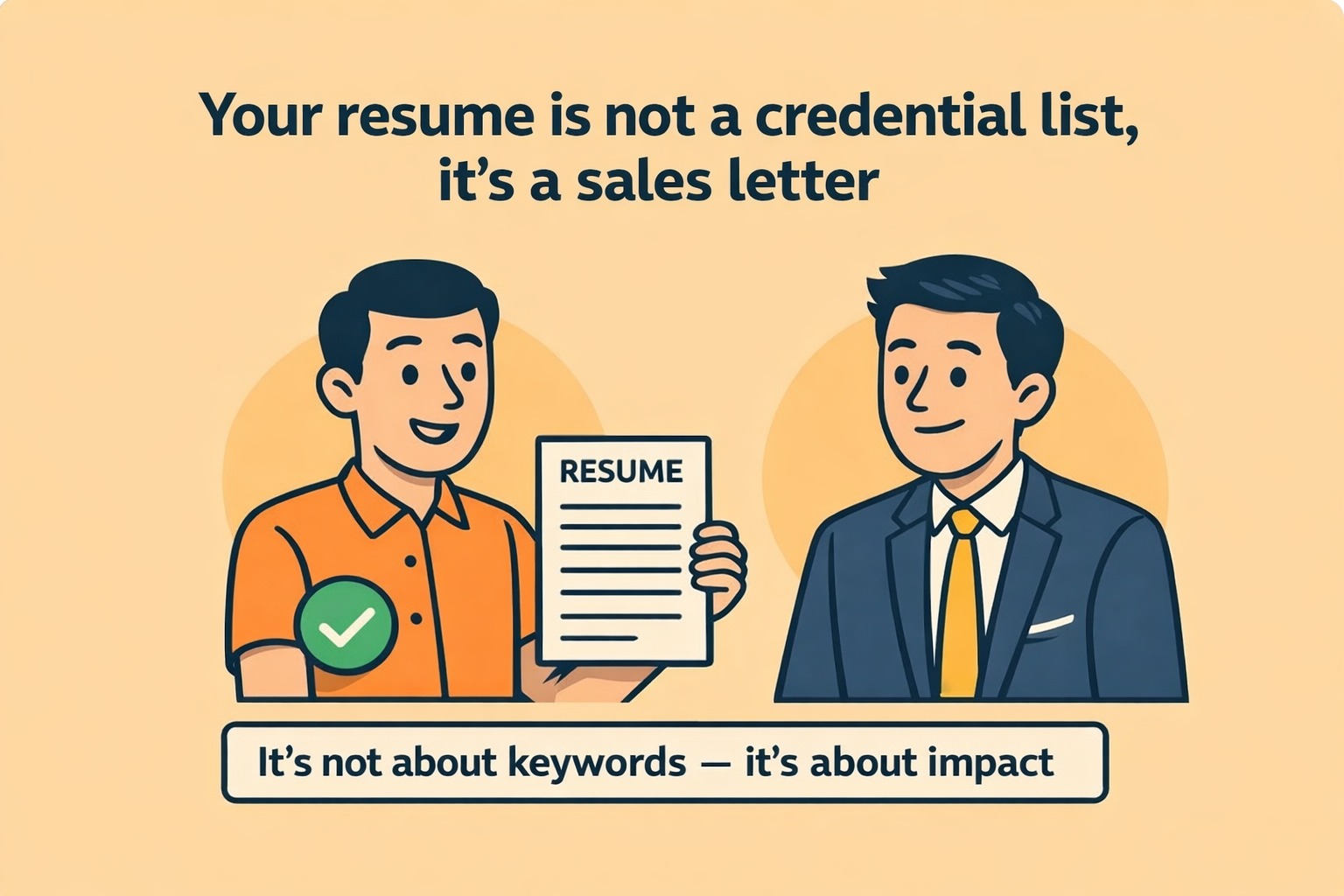
It’s a Sales Letter
Most product managers treat their resume like a compliance document.
- A record
- A ledger
- A list of things that happened
That’s the mistake.
Your resume is not a historical artifact.
It’s a sales letter.
And once you see that clearly, a lot of resume advice suddenly becomes… clearly… wrong.
Hiring Managers Don’t Read Resumes Like Auditors
Hiring managers don’t sit down with a resume thinking:
“Let me carefully evaluate whether this person meets every requirement.”
They’re thinking:
“Is this person worth my limited time and attention?”
That’s buyer behavior.
And buyers don’t want documentation.
They want clarity, relevance, and confidence.
Think about how you behave when buying a product:
- You skim first
- You look for signals
- You’re asking, “Is this for me?”
That’s exactly what a hiring manager is doing with your resume. (You’re the product!)
A Resume Has One Job
A sales letter has one job:
Get the reader to take the next step.
Your resume is no different.
Its job is not:
- To prove you can do the job
- To show everything you’ve ever worked on
- To satisfy an ATS checklist
Its job is to make the hiring manager say:
“I want to talk to this person.”
That’s it.
Everything on your resume either supports that goal —
or actively undermines it.
Why “Selling Yourself” Feels Uncomfortable
Many PMs resist this framing because selling yourself feels “uncouth.”
But here’s the paradox:
You are already selling yourself.
You’re just doing it badly.
A boring resume doesn’t feel neutral. It signals:
- Low confidence
- Low differentiation
- Low self-awareness
That’s not humility.
That’s invisibility.
Great sales letters don’t brag.
They demonstrate relevance.
And great resumes do the same.
What Sales Letters Do — And What Resumes Must Do
A strong sales letter:
- Positions the product
- Shows the problem it solves
- Demonstrates that it works
- Differentiates it from alternatives
- Reduces buyer anxiety
- Makes action easy
Now translate that to a resume.
Your resume must
- Position you clearly (“What kind of PM is this?”)
- Show what problems you’ve solved
- Demonstrate impact
- Differentiate you from other qualified candidates
- Pre-handle objections (“Can they do this here?”)
- Make the next step obvious (an interview)
Most resumes fail at every single one of these.
Why Most PM Resumes Are Boring – (Even When the PM Isn’t)
Here’s the pattern I see constantly:
- The resume is generic
- The conversation is amazing
In conversation, the PM tells me about:
- Huge challenges
- Political complexity
- Real stakes
- Meaningful outcomes
None of that appears on the resume.
Instead, I see:
- Job descriptions
- Activity lists
- Responsibilities anyone in the role could claim
That’s not selling.
That’s camouflage.
You Don’t Need Creativity – You Need Intent.
Resumes are a constrained format. That’s real.
But constraint doesn’t mean passivity.
Within the rules of a standard resume, you can:
- Create curiosity
- Signal authority
- Differentiate yourself
- Show impact
- Build desire
You just have to stop thinking like a historian — and start thinking like a PM taking a product to market.
Because that’s exactly what you’re doing.
If this reframing feels uncomfortable, that’s a signal — not a problem.
It usually means your resume isn’t doing justice to the work you’ve already done.