
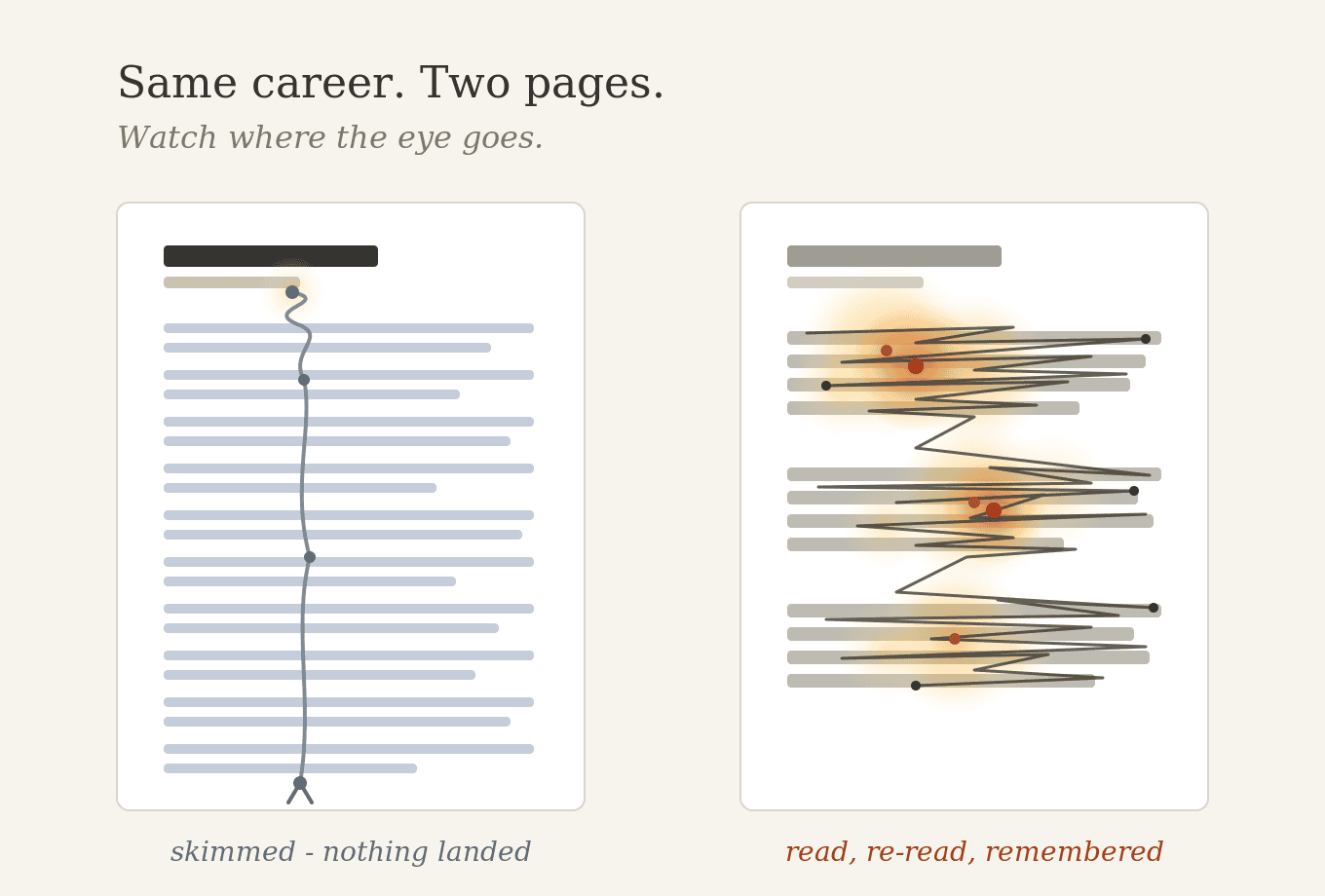
Everything you’ve ever been told about resume bullets says keep them short. One line. Punchy. A verb, a thing, a number if you’ve got one. “Architected a multi-agent personalization system powered by contextual multi-armed bandit models.” Done.
Here’s the problem with that bullet: nobody who reads it wants to talk to you.
I’ve watched this play out across dozens of resumes now, and the pattern is hard to argue with. People come to me not getting interviews – months of silence, sometimes a year – with resumes full of exactly those tight, technical, one-line bullets. We rewrite them as longer bullets. Three sentences instead of one. And the interviews start. Not always overnight, but the change is real enough, and consistent enough, that I’ve stopped treating it as a coincidence.
So let me make the case for the longer bullet. First the proof, because you should be skeptical. Then what the hiring manager is actually looking for – because that’s the thing the whole argument rests on. Then the mechanism: why the longer bullet works. And then the part nobody tells you, which is why almost nobody does it well.
First, how do I know they work?
The honest answer: outcomes. People weren’t getting interviews. We changed the bullets. They started getting interviews – and offers.
Now, you’re a PM. You’re already drafting the objection: that’s correlation, not causation. Maybe the market shifted. Maybe they applied to more jobs. Maybe the people who hire a coach are just more motivated, and that’s what’s actually moving the numbers (survivorship bias, dressed up). Fair. I can’t run a randomized controlled trial on someone’s career.
But here’s what makes me confident it’s the bullets and not the noise. The only thing that changed in many of these cases was the resume. Same person, same experience, same target roles, same market – applying the week before and the week after. Nick went three months with no interviews, rewrote his resume and LinkedIn, and had an offer sixteen days later. Brenna had been silent for months, finished her rewrite, and had an interview that same week and an accepted offer three weeks after. When you hold everything constant except the document, and the document is what flips the result, the document is doing the work.
So the longer bullets work. To see why, you have to look at the problem from the other side of the desk.
What the hiring manager is actually looking for
Here’s something most candidates never think about. Before that job ever got posted, the hiring manager had to go to their leadership and get the role approved. And they didn’t do it by listing skills. They did it by naming a problem.
The conversation went something like: “We have this business problem. If we don’t solve it, the business is going to suffer. To solve it, I need a product manager. And if I get that person, here are the outcomes I’m promising you.”
Sit with that, because it changes everything about what your resume is for. The hiring manager is thinking about a problem and the outcomes they promised. Skills? Skills are assumed. Roadmapping, cross-functional collaboration, writing PRDs – of course you can do those; so can everyone else in the stack. Those are the price of admission, not the reason anyone gets hired.
And usually it’s not one problem, it’s a cluster. The same handful comes up over and over for PM hiring managers: delivery’s too slow, customers are unhappy, churn and retention are heading the wrong way, the team isn’t working well together, cross-functional collaboration is broken or missing entirely. The hiring manager has some mix of these, sharply felt, and they’re betting a new PM will fix it.
And here’s the kicker: none of that – not the problem, not the promised outcome – shows up in the job description. The JD lists the requirements. It does not list the actual job. The actual job is the problem the hiring manager is quietly desperate to solve and didn’t write down.
So your resume has exactly one job, and it’s not “describe what I did.” It’s this:
- Prove you can solve the kind of problem they have.
- Give them a reason to choose you over other people who are also qualified.
- Make it so obvious they get it in five seconds.
A one-line task bullet does none of those three things. A story bullet does all of them. That’s the entire argument – everything below is just the mechanism for why.
1. Humans are wired for stories, and a problem is the start of one
Lead a bullet with the problem and you’ve done something sneaky: you’ve made the reader want to know what happens next. “Churn surged as customers kept hitting missing or wrong emails in our search engine.” Okay – now what? You’ve opened a loop. The brain wants it closed.
A one-line accomplishment bullet opens no loop. “Improved email data quality 15% across 1B profiles.” There’s nothing to resolve, because there was never any tension. It’s an answer to a question nobody asked. Compare:
Before: Increased customer ROI by optimizing contact ranking, leading to a 15% improvement in email availability and quality for over 1B profiles.
After: Churn surged as customers hit missing or wrong emails in our people-search engine. When leadership stalled, I dug in with my team and found flawed UI code hiding correct data. Fixing it and enhancing the algorithms improved coverage and accuracy by 30%, slashed complaints, and rebuilt our market reputation.
The second one you read to the end. The first one your eye slid right past. That’s not a writing-quality difference. That’s structure – the problem creates the pull. And notice what the problem-first bullet does for the hiring manager specifically: it lets them recognize their own situation in your work. Churn, stalled leadership, a quality issue nobody’s owning – if that’s the problem keeping them up at night, you just became the person who’s solved it before.
2. The solution shows your agency – that you did the deciding
This is the one people miss. A task-based bullet tells the reader you did something. It does not tell them whether the doing was yours. “Owned the roadmap for migrating legacy storefronts to a React-based platform” – did you decide to migrate, or did someone hand you the migration and you ran the project? The bullet can’t tell, so the reader assumes the smaller version. (They always assume the smaller version. That’s the whole problem.)
The middle of a story bullet – the solution – is where you show the judgment was yours. “When leadership stalled, I dug in.” “I cut through a stalled, overengineered effort and redefined a simpler approach.” “I reframed pricing as a product problem.” Those aren’t tasks. They’re decisions. And decisions are exactly what the hiring manager is buying – remember, they need someone to solve a problem they can’t fully specify in advance. They’re not hiring a pair of hands to execute a known plan. They’re hiring judgment to navigate a problem that’ll shift on contact.
A senior PM who can only describe tasks reads as someone who executes other people’s thinking. A senior PM who describes decisions reads as someone who does the thinking. Same person, same work – but only one of those resumes shows it.
3. The transformation resolves the tension – in the terms leadership cares about
You opened a loop with the problem. The transformation closes it. And it closes it in business terms – which, not coincidentally, are the exact terms the hiring manager used to get the role approved.
Remember what they promised their leadership: outcomes. So when your bullet ends in outcomes a non-specialist can evaluate, you’re not just finishing a story – you’re handing the hiring manager the exact language they need to justify hiring you. “Hybrid LLM/OCR solution with 90% accuracy” asks the reader to judge whether 90% is good (they have no idea, and neither does the VP they’ll have to convince). “10x accuracy, 2x speed, 50% cost reduction” asks them to judge whether faster and cheaper is good. Obviously it is. You’ve written the outcome half of their job-req pitch for them.
Before: Led 0-1 build for metadata extraction and comparison utilizing OCR technologies with accuracy up to 90%.
After: Our manual contract metadata process created delays, errors, and compliance risk. I led end-to-end discovery, designed a new UX, and implemented a hybrid LLM/OCR solution. The result: 10x accuracy, 2x speed, 50% cost reduction, and a dramatically improved onboarding experience for customers.
The before makes the reader work. The after does the work for them – and arms them for the conversation they’ll have about you when you’re not in the room.
4. They speak to the problem the job description left out
Here’s the reframe that ties it together. The short technical bullet answers the job description – the stack, the model, the acronym, the listed requirement. But the job description was never the real question. The real question is the problem the hiring manager didn’t write down and the outcome they promised to deliver.
A keyword-stuffed task bullet says “I match your requirements.” Fine – so do the other 499 applicants. A story bullet says “I’ve solved the problem you actually have.” Only one of those answers the question the hiring manager is really asking.
Look at what happens when a big number gets in the way of its own story:
Before: At IBM, led Watsonx Code Assistant’s GTM strategy, driving $27.9M in revenue.
After: Watsonx Code Assistant faced low adoption due to quality concerns and developer resistance. I led internal enablement – office hours, usage guides, prompting scenarios – to build trust. Engagement climbed, adoption started rising, and we were positioned to win back ground from GitHub Copilot.
The before has a bigger number ($27.9M!) and tells you nothing about what the person actually did to earn it. The after has no dollar figure and tells you exactly what kind of operator they are: someone who diagnoses why a launch is stalling and fixes it from the inside. If your problem is “we shipped an AI tool and nobody’s adopting it” – and right now, that’s a lot of hiring managers – the second person is the one you call. The number was never the point. The match to the problem was.
The part nobody tells you: this is hard, and that’s why it works for you
Notice I didn’t list “it takes effort” as a reason the longer bullet works. Effort isn’t why it works. The reader doesn’t reward you for trying hard – they don’t see the trying.
But the effort is why it’s rare, and rare is exactly what you want.
Here’s the reality: you cannot write a good story bullet from memory in five minutes. The problem-solution-transformation underneath it has to be excavated. What was actually broken? What did you specifically decide? What changed because of it – in numbers a stranger can understand? Most people can’t answer those questions about their own work off the top of their head, which is why most resumes default to the task list. The task list is what’s easy to write. (It’s also what everyone else writes, which is the trap.)
So when the standard advice says “just add a metric to your bullet,” understand what’s happening: that advice is cheap because it’s easy to follow, and it’s easy to follow because it doesn’t require you to actually dig out the story. It produces a slightly shinier task list. It does not produce a reason to call you.
The longer bullet is harder. That’s the point. In a stack of 500 applicants who all took the easy path – matching the requirements, listing the skills, answering the job description instead of the problem behind it – the person who did the digging is the one who’s obviously the right fit in the first five seconds.
Bottom line: keep the bullet short and you save yourself an afternoon. Make it a story and you might save yourself the next six months of silence. That’s the trade. It’s not close.