
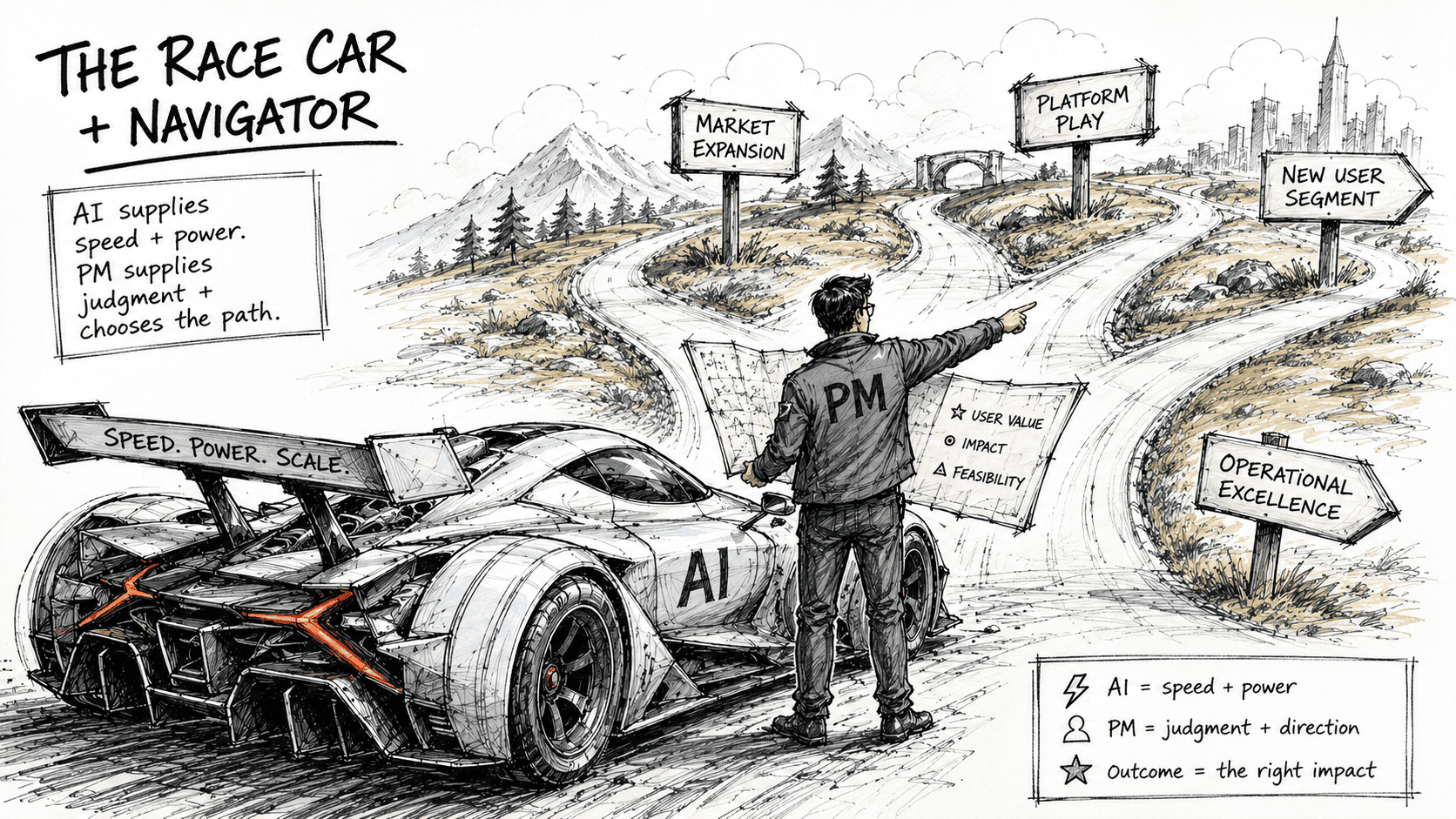
There’s a version of the product manager AI debate that I find exhausting, and a version that I find genuinely interesting.
The exhausting version: will AI take product manager jobs? The interesting version: what does AI actually change about what good product management looks like?
Here’s my answer, based on a lot of time working with AI tools and a lot of time watching how product managers work: AI is a highly capable assistant with no instincts. And that distinction matters more than most people realize.
What AI is actually good at
AI can synthesize large amounts of information faster than any human. It can hold an entire conversation history, product brief, competitor landscape, and user research corpus in working memory simultaneously. It can generate options – lots of them, quickly. It can draft, structure, analyze, and iterate without getting tired or losing patience.
If you point it at a well-defined problem, it will do more work, faster, than you could do alone. That’s real. The product managers who dismiss this entirely are going to find themselves at a significant productivity disadvantage.
But there’s a catch. A significant one.
AI doesn’t know when it’s answering the wrong question
AI is confident. Consistently, thoroughly, impressively confident – regardless of whether it’s working within the right frame. It will answer whatever question you ask it. It has no instinct for whether that question was worth asking in the first place.
It can’t tell you “I think you’re solving the wrong problem.” It can’t notice that the metric you’re optimizing is a proxy for the thing you actually care about, and the proxy has started to diverge. It can’t feel the difference between a user complaint that’s a symptom of something deeper and one that’s just noise.
An experienced PM can. Not because of intelligence – AI is plenty intelligent. Because of instincts built from years of being wrong in specific, instructive ways.
You’ve optimized for the wrong metric before and watched the business result not improve. You’ve shipped the feature users asked for and seen them not use it. You’ve watched a team converge on a solution three weeks before they’d actually understood the problem. Those experiences build a pattern-recognition system that no amount of training data replicates.
AI has training data. You have instincts. Not the same thing.
The right frame: amplification, not replacement
Think about how a senior PM works with a good analyst. You don’t hand the analyst the strategy and tell them to run it. You point them at specific problems, give them enough context to do useful work, review what comes back, and redirect when they’ve gone down a path that isn’t productive. The analyst multiplies your capacity. You supply the judgment about what’s worth analyzing.
That’s the right model for AI. An analyst who’s available at 2am, never gets tired, can hold more context than any human, and will cover in an hour what used to take a week.
With a firm hand guiding it, AI multiplies your individual capacity to explore a problem space in ways that weren’t previously possible. You can run more experiments in your thinking, check more assumptions, explore more of the option space before committing.
Without that hand, it produces very confident, very thorough work in whatever direction you pointed it – which may or may not be the right direction.
What This Means for Product Manager AI Careers
The PMs who are going to be genuinely formidable in the AI era aren’t the ones who know the most AI tools. They’re the ones who bring the clearest instincts about which problems are worth solving – and who’ve learned to use AI to cover more ground once they know where they’re headed.
The skills that make this possible – knowing when a team has latched onto a solution before they’ve understood the problem, reading which user pain points are symptoms of something structural, knowing when to trust the data and when the data is measuring the wrong thing – those are exactly what doesn’t get automated. They’re the output of years of PM experience. And they become more valuable as AI handles more of the execution work.
The anxiety about AI replacing PMs gets it backwards. The PM who’s deeply experienced, with well-developed instincts, and who knows how to use AI as a force multiplier – that PM can now do what used to require a team. That’s not a threat. That’s a significant advantage.
But it only works if the instincts are there to start with. AI amplifies what you bring. If what you bring is uncertainty about which problems matter, it will amplify that too.
Bottom line: AI is great at answering questions. The PM’s job – figuring out which questions are worth asking – isn’t going anywhere.
I work with senior PMs on the skills that actually move the needle in a job search – including how to articulate the judgment and instincts that make them valuable. Book a free resume review here.