
Everyone is using AI to write their resume right now. And most of them are getting worse results than if they’d just done it themselves.
That’s not a knock on AI. It’s a knock on how people are using it — and once you understand why it goes wrong, the fix is surprisingly simple.
Here’s the counterintuitive truth about using ChatGPT for your resume: the moment you tell it you’re working on a resume, you’ve already lost.
The Training Data Problem
ChatGPT has read millions of resumes. That sounds like a feature. It’s actually the bug.
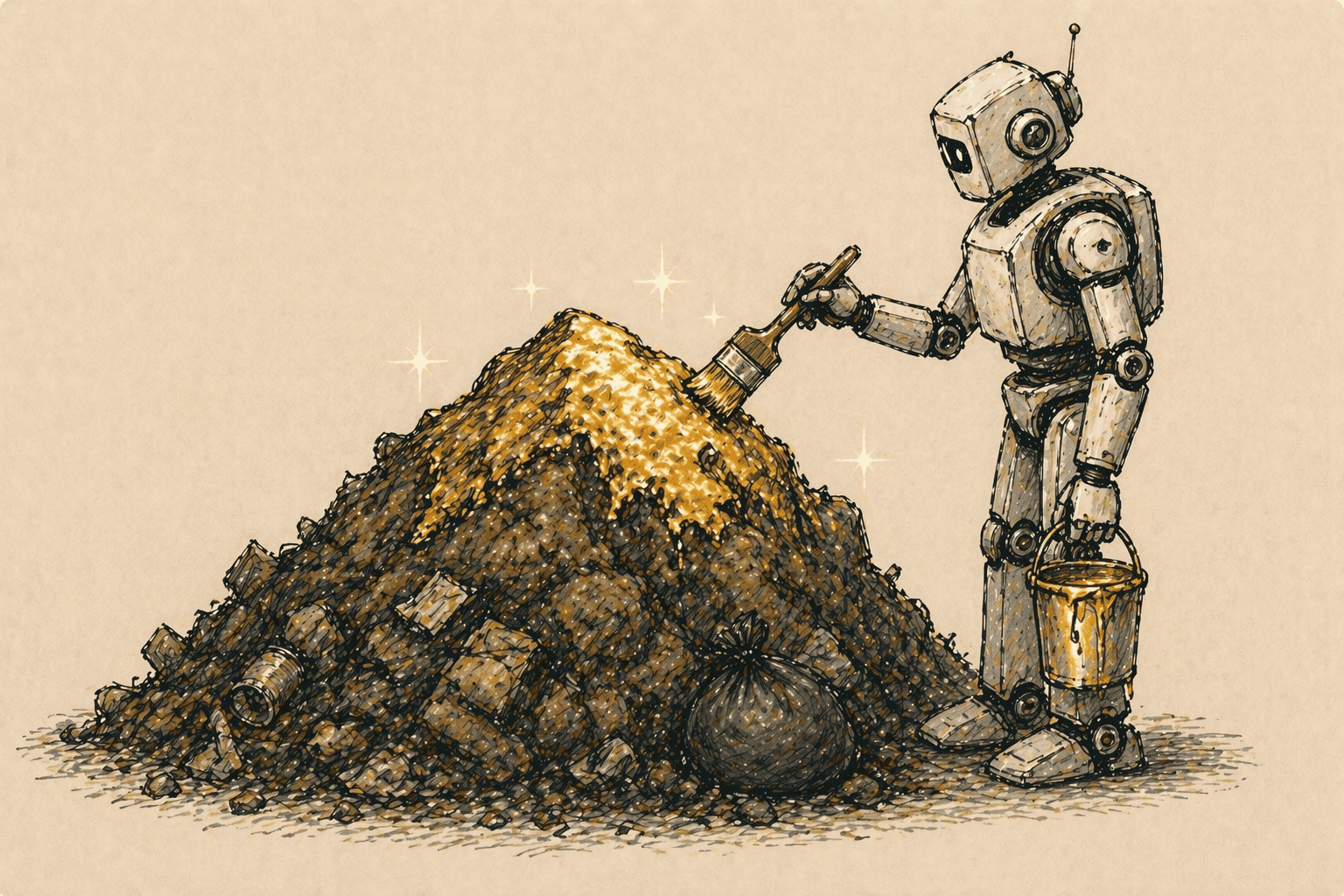
Because the vast majority of those resumes are bad. They’re full of the same hollow phrases you’ve seen a thousand times: “results-oriented professional,” “spearheaded cross-functional initiatives,” “leveraged synergies to drive impact.” The internet is a graveyard of task-list resumes that describe what people did without ever explaining why it mattered.
ChatGPT learned from all of it. So when you say “help me write my resume,” it reaches for exactly those patterns — confidently, fluently, and completely wrong. It knows all the (wrong) rules. It produces polished-sounding garbage because that’s what most resume “help” on the internet looks like.
This is what I mean when I say the resume clouds the mind — yours and the AI’s. The moment “resume” is in the conversation, both of you start thinking about the format, the conventions, the word count per bullet. You stop thinking about the story.
The Workaround: Ask for Stories, Not Resume Bullets
Here’s what I actually do in my coaching work. I use ChatGPT to help clients draft what I call their customer success stories — vivid, narrative versions of their biggest achievements. And I never tell it I’m working on a resume.
I ask it to help me write a story. Specifically, a story about a business problem someone solved.
That reframe changes everything. ChatGPT stops pattern-matching to resume conventions and starts thinking like an editor helping you make a narrative compelling. The output is completely different — more specific, more dramatic, more human.
Eventually, those stories become resume bullets. But we get there by going through the story first, not by asking AI to write bullets directly. (And yes, the irony is that the “longer path” produces shorter, sharper bullets than the direct approach ever does.)
The Framework: What to Give ChatGPT to Get Real Results
Here’s the kicker though: even with the right framing, ChatGPT will fail you if you give it incomplete information. This is the part most people skip, and it’s why their AI-assisted resumes still come out flat.
For ChatGPT to produce a compelling story, you have to give it everything. Specifically:
- The problem and all its symptoms. What was broken, at risk, or missing? What were the business consequences? The more specific here, the better — “we were losing customers” is not enough; “we had a 34% annual churn rate driven by three recurring support issues” is the kind of detail that produces a real story.
- What you actually did. Not just the outcome — the sequence of actions, from figuring out the problem through persuading leadership to fund the solution, through taking it to market. The discovery and the doing, not just the building.
- The impact, in multiple dimensions. Revenue, time, customer satisfaction, team efficiency — whatever changed as a result. Ideally with numbers, but qualitative outcomes are valid too if they’re specific.
If you leave any of this out, ChatGPT does one of two things: it makes it up (turning your story into a fable with invented metrics) or it skips it (making the story boring and generic). Neither version gets you interviews.
The underlying truth here is that ChatGPT isn’t actually writing your story. It’s shaping and dramatizing information you’ve already provided. Think of it as a very fast, very patient editor — one that will work with whatever raw material you hand it. Give it good raw material, get a good story. Give it vague inputs, get vague outputs. Garbage in, garbage out, right? AI doesn’t change that law.
What AI Is Actually Good For (And What It Isn’t)
Once you understand this, it’s easier to see where AI genuinely helps in a job search — and where it actively hurts you.
AI is useful for: Taking a detailed story you’ve outlined and making it flow. Generating multiple phrasings of the same bullet so you can pick the sharpest one. Checking that your narrative arc makes sense. Helping you condense a 200-word story into a 45-word bullet without losing the substance.
AI is not useful for: Figuring out what your strongest stories are. Identifying what a hiring manager would care about in your specific background. Knowing what “good” actually looks like in your target role. Writing bullets when all you’ve given it is your job title and a list of responsibilities.
That last one is the trap most people fall into. They paste in their current resume, ask ChatGPT to “improve” it, and get back a shinier version of the same task list — with better punctuation and more confident language, which somehow makes it worse. Now the mediocrity is polished.
The work that AI can’t do for you is the work of excavating what actually happened, why it mattered, and what made your contribution specific to you. That’s the human part. Once you’ve done it, AI can help you say it better. But it can’t do the excavation.
Three Things You Can Do Today
- Pick one achievement and write out the raw story — problem, what you did, what changed. Don’t worry about bullet format yet. Just write it out. Then ask ChatGPT to turn it into a compelling one-paragraph story. See what it gives you.
- Never say “resume” to the AI. Say “story,” “narrative,” “customer success story.” Watch how the output changes.
- Give it more context than you think you need. The version of the story with twice as much input almost always produces twice as good output. AI doesn’t get tired of details. You can’t over-explain to it.
Bottom line: AI is a powerful tool for resume writing — but only if you understand what it actually does. It’s an editor, not a strategist. It needs real information to produce real results. And the moment you ask it to “write your resume,” you’re asking it to do the one thing it’s worst at.
Use it right, and it can cut hours off the work. Use it wrong, and it makes your resume sound like every other resume out there — which, tbh, is the whole problem you were trying to solve.
If you want help figuring out which of your stories are worth telling — and how to tell them in a way that makes hiring managers stop scrolling — book a free resume review here. We’ll find the moments your current resume is burying and figure out how to surface them.